
 If you’ve been working on building your dog’s focus amid distractions—as outlined in our Week 2 exercise—you’re ready for the next step: proofing your dog’s focus with distractions.
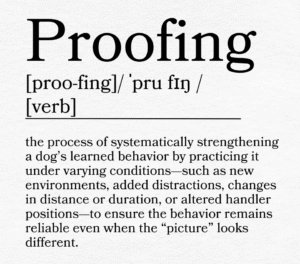
Proofing is how we help dogs respond to familiar cues even when the picture changes. Dogs don’t automatically understand that a behavior learned in one place applies everywhere. A cue that feels solid in a quiet living room can feel brand new in a different room, a busier environment, or during a more stimulating moment.
This doesn’t mean your dog has “lost” their focus. It means the learning is still context-specific.
Proofing bridges that gap. It helps your dog recognize familiar cues across changing environments by slowly layering in new variables—without pressure, frustration, or overwhelm. When done thoughtfully, proofing builds reliability, not rigidity.
This step is often overlooked in dog training, largely because many people don’t realize how much support dogs need to truly generalize a skill. But the time you invest here pays off in a big way. The stronger your dog’s focus becomes under distraction, the easier every other behavior will feel—loose-leash walking, recalls, stays, and even everyday communication.
Here’s the beauty of Week 4:
If you’re having a day when you or your dog feel extra distracted, you can always return to the Week 2 focus exercise. You’re still strengthening the foundation. On days when things feel calmer, this week’s work helps you begin proofing your dog’s focus in real-life situations, gently and intentionally.
That flexibility is part of the training—not a detour from it.
From Learning a Skill to Proofing It
 Our Week 2 exercise teaches your dog what to do when distractions appear. This week, we teach them something more advanced: the same rules apply even when the context changes.
The more your dog practices a behavior across different environments, situations, and emotional states, the more likely they are to truly understand the cue—not just recognize it in one familiar setting.
This is the heart of proofing your dog’s focus with distractions.
As you work through this stage, keep one of my core training mantras in mind:
Train, don’t test.
If your dog looks confused when the picture changes, that’s not a failure. It’s information. Confusion tells us the learning isn’t finished yet—and that our job is to coach, not correct.
That means thoughtfully changing the picture and asking your dog for behaviors they already know, while staying mindful of what might feel different from their perspective. Small changes in environment, movement, noise, or even your own body language can all affect focus.
Mindful training sessions invite you to notice:
- what pulls your dog’s attention most strongly
- which changes feel easy
- which changes require more support
Those observations guide smarter proofing.
Proofing Don’ts (Common Traps to Avoid)
When proofing focus, it’s easy to unintentionally turn practice into a test. These reminders help keep learning on track:
❌ Don’t assume “they know it” means they can do it everywhere
Dogs don’t generalize automatically. A cue that’s solid at home hasn’t been proofed until it’s practiced in other contexts.
❌ Don’t raise criteria too quickly
Jumping from a quiet living room straight to a busy park sets dogs up to fail. Big leaps overwhelm learning.
❌ Don’t punish mistakes during proofing
Errors mean the picture changed too much—not that your dog is being stubborn or noncompliant.
❌ Don’t proof when your dog is already over threshold
If your dog is reacting, frozen, frantic, or unable to disengage, you’re no longer proofing—you’re flooding. Step back and support regulation first.
Proofing Dos (How Learning Stays Intact)
These guidelines help proofing feel safe, and productive
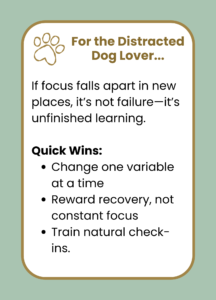
✅ Do change only one variable at a time
Increase distraction, distance, duration, or environment—never all at once.
✅ Do return to an easier version if your dog struggles
Proofing gives you information. If the behavior falls apart, lower the difficulty and rebuild from there.
✅ Do reinforce generously when the picture changes
New environments and distractions deserve better paychecks, not fewer rewards.
✅ Do practice in short, successful sessions
Proofing works best in brief, focused reps that end on success. A minute or two is often plenty.
Focus Isn’t Failing—It’s Still Being Built
When dogs first learn a focus skill, they’re learning it within a very specific picture.
The environment is familiar. The distractions are controlled. The handler’s body language is predictable. Success feels easy.
That doesn’t mean the skill is fragile.
It means the skill is still tied to context.
When we frame it this way, it becomes much easier to see that our dogs aren’t failing. What can look like failure through a human lens is often just information—information we can use to build more thoughtful, complete training plans.
And to be clear, this doesn’t mean we should intentionally put our dogs into situations where we already know they’re unlikely to succeed. Proofing isn’t about throwing dogs into the deep end.
However, when you do encounter an environment where your dog struggles to focus, that moment tells you something important: this is a picture your dog hasn’t practiced yet.
That’s valuable information.
From there, we collect the data and create more manageable versions of that situation—adding distance, lowering intensity, or simplifying distractions—so we can reinforce attention and focus before things become overwhelming.
What Can Make Focus Feel Inconsistent During Proofing
As you proof your dog’s focus with distractions, pay attention to these common variables that can dramatically change the picture for your dog:
Stacked Distractions
Your dog may focus easily when a familiar dog walks by. But the picture changes completely if you’re in a pet store with multiple animals, new scents, food displays, and tight spaces. Each added element multiplies the challenge.
Changes in Your Dog’s Internal State
If your dog is already excited, stressed, overtired, or emotionally charged, focus will naturally be harder—just as it is for people. Learning doesn’t happen in a vacuum.
Sudden Environmental Changes
Dogs are hardwired to notice novelty and change. In fact, many breeds were intentionally developed to alert to movement, sound, or environmental shifts. We can’t ask dogs to simply “turn that off” without thoughtful conditioning.
When your dog loses focus under these—or any—circumstances, try reframing the moment. Instead of thinking:
“My dog can’t focus.”
Shift to:
“My dog hasn’t practiced focus in this version of the world yet.”
That single reframe changes frustration into curiosity—and puts you back into coaching mode.
Why this can be frustrating
Proofing lives in a grey area. You’ve already built a lot of success, so when your dog doesn’t respond the way you expect, it can be hard to know what to do next.
Sometimes we expect our dogs to respond in certain environments—and then they tell us they can’t.
That’s okay.
We’re human. No one is perfect. And training isn’t linear.
This is the moment to observe, not react. Ask yourself:
- Where is my dog’s attention right now?
- What is my dog’s emotional state?
- What is my emotional state?
All of these pieces influence how different the picture feels to your dog.
During this stage of training, you’ll naturally seek out new environments to proof behaviors. When you hit a block and focus isn’t there yet, the answer isn’t to push harder—it’s to make the exercise easier.
That might mean taking baby steps from the last successful version of the exercise toward a new environment. And that is absolutely okay.
Any step forward—even a small one—is still progress.
Skill: Recovery, not disengagement
This week, we’re shifting the skill we’re reinforcing. Instead of asking your dog to disengage before something happens, we’re focusing on calm observation followed by recovery.
In other words, your dog can notice what’s happening in the environment without losing emotional balance or connection.
This distinction matters.
For years, I’ve seen well-intentioned dog owners ask their dogs to maintain constant eye contact in distracting environments—often in an effort to prevent reactions before they start. I understand the logic. If the dog never looks away, they won’t react to what they see.
But in practice, this approach often creates more tension, not less.
Dogs know there’s something in the environment they want—or need—to check out. When they feel they can’t look, their nervous system stays on high alert. Instead of processing the information, they’re suppressing it.
And suppression is exhausting.
Think about it this way: when was the last time someone told you, “Don’t look behind you!”
What was the very first thing you wanted to do?
I’ve worked with many dogs who learned that a “watch me” cue actually predicted something exciting—or overwhelming—was nearby. Over time, the cue itself became arousing. Instead of calming the dog, it raised anticipation.
That’s not what we want.
Why Recovery Builds More Reliable Focus
When we teach dogs that calm engagement with the environment is allowed, we support a much healthier emotional process.
Your dog notices something.
They take it in.
They recover.
They reconnect.
That sequence builds resilience.
Recovery teaches your dog:
- they don’t need to ignore the world to stay connected to you
- curiosity is allowed
- focus can return naturally, without pressure
This is a critical piece of proofing your dog’s focus with distractions. We’re not asking dogs to hold attention indefinitely. We’re teaching them how to come back after attention shifts.
And that’s the skill that holds up in real life.
Week 4 Exercise — Notice, Pause, Return
This exercise is designed to build recovery skills, not force focus. Your dog is allowed to notice what’s happening in the environment. The learning happens in the pause—and in the choice to return attention to you.
Set-Up
- A real-life environment (living room, hallway, yard, porch)
- Low-level, existing distractions (nothing staged or intensified)
- Dog on a leash or long line for safety, not control
- High-value, easy-to-deliver rewards
This is not a formal training setup. The more natural the environment feels, the more meaningful the learning will be.
How the Exercise Works
- Wait for natural engagement
Allow your dog to notice something in the environment—smells, movement, sound. No cues. - Allow the distraction to happen
Resist the urge to jump in or redirect. Observation is part of the process. - Pause instead of prompting
This pause is critical. It gives your dog space to process and choose. - Mark the choice to check in with you
The moment your dog looks back at you—softly and voluntarily—mark it. - Reward calmly
Deliver the reward without excitement. We’re reinforcing recovery, not ramping arousal. - Repeat briefly
A few successful reps are plenty.
Real-Life Progression Examples
I like to start this exercise in my backyard, where the primary distractions are smells. This keeps the picture simple and sets the dog up for success.
From there, I graduate to sessions on my front porch. I’ll sit in a chair with my dog while the distractions are dogs or people walking by on the sidewalk or street—usually about 20 feet away.
If your dog needs more distance, a parking lot can be a great option. Start at the far edge where your dog can observe people getting in and out of cars while still having enough space to stay regulated.
Distance is your friend here.
Session Length & Progression
- Start with 30–60 second sessions
- Increase duration only when the exercise stays successful
- Short sessions protect the nervous system and keep learning clean
As your dog becomes more skilled, you can switch from a short leash to a long line. Allowing more movement increases difficulty naturally, so keep sessions short and intentional.
In separate sessions—not all at once—you can also begin to decrease distance from distractions. If at any point your dog stops choosing to check in, that’s simply feedback that you moved too close, too fast.
Add distance. Build value. Try again later.
That’s proofing.
End on a High Note
Always end a session while your dog still wants to engage. Stopping early helps your dog jump into the next session with enthusiasm instead of hesitation.
I want both you and your dog to love training. Proofing should feel supportive, not stressful.
Troubleshooting: When Proofing Feels Hard
Proofing isn’t about perfection. It’s about gathering information. If something feels off, use it as data—not a reason to push through.
My dog doesn’t check back in
This usually means the distraction is too close, too intense, or stacked with other variables.
Try this instead:
- Increase distance from the distraction
- Choose a quieter environment
- Lower the duration of the session
My dog is hyper-focused on the environment
When attention gets “sticky,” your dog may be struggling to regulate, not choosing to ignore you.
Try this instead:
- Pause the session
- Add movement (walk away from the distraction together)
- Switch to a sniff break or scatter feed
Regulation comes before learning.
My dog checks in, but seems tense
I am so happy you are aware of this and know this indicates that it is time to adjust. Focus isn’t just about looking—it’s about how the body feels.
Try this instead:
- Slow down reinforcement delivery
- Use calmer rewards
- End the session earlier
Soft focus matters more than fast focus.
My dog does well at first, then falls apart
This is a sign of mental fatigue, not stubbornness.
Try this instead:
- Shorten your sessions
- Reduce the number of reps
- Stop while things are still going well
Proofing works best in small, clean moments.
How This Builds Toward Real Life Focus
Real-life focus isn’t about ignoring the world—it’s about recovering from it.
That distinction matters. Dogs don’t live in controlled training setups. They live in a world full of movement, sound, scent, and change. When your dog learns that they can notice those things and then choose to reconnect with you, everything else becomes easier.
A dog who can calmly check in amid distractions is a dog who can:
- walk on a loose leash past real-life triggers
- respond more reliably to recalls
- recover faster when something unexpected happens
This is why proofing focus is such a powerful investment.
When people ask me how I built such strong off-leash reliability with my lab, the answer isn’t a single cue or a magic technique. It started here—with focus, and more importantly, with proofing that focus across different environments and situations.
This work teaches dogs that connection doesn’t disappear when the world gets interesting. It simply pauses—and then comes back.
That’s real-life reliability.
In Conclusion
Spending just a few minutes a day playing this game can build meaningful engagement with your dog while strengthening a skill that supports every other behavior you teach. Proofing focus doesn’t require long sessions or perfect conditions—it grows through small, thoughtful moments practiced consistently.
Focus isn’t just a behavior to train. It’s a way to communicate. It’s information flowing both ways. When your dog learns that they can notice the world and still return to you, trust deepens and learning becomes easier.
So take a few quiet minutes today. Sit, observe, pause. Let your dog notice—and then celebrate the moment they choose connection. That choice is the foundation of real-life focus, and it’s one of the most powerful skills you can build together.
For more in the Distracted Dog Lover’s Focus series see:
Week 1: Micro Training and the Name Game
Week 2: Focus Amidst Distraction
Week 3: Building Calm to Help Your Dog Focus
Please note: This post may include affiliate links. If you make a purchase through these links, I may earn a commission, at no additional cost to you. Thank you for helping keep this blog running!