
How can you tell you’re on a blog written for neurodivergent dog lovers by a neurodivergent dog trainer?
I’m sharing my favorite dog Christmas gift ideas less than one week before Christmas.
The good news? Your dog does not care if these show up on December 25th… or the 26th.
Or New Year’s. Or St. Patrick’s Day. Or a Tuesday.
What dogs really want is more opportunities to interact and connect with you — and these toys fit the bill perfectly.
This isn’t a generic gift guide. When I was training dogs for scent detection work, I developed a deep appreciation for toys that could genuinely hold a dog’s attention and keep them engaged. These are the kinds of toys that earned a permanent place in my training bag.
I don’t just use these toys during play sessions — I use them in training. They help build engagement, motivation, and focus in a way that feels fun for both the dog and the handler.
While you can find toys similar to Tug-E-Nuff’s, what I’ve consistently appreciated about their products is the quality. My dogs are rough on toys, and although we’ve tried plenty of look-alikes over the years, the Tug-E-Nuff versions have simply held up better with my crew.
That’s why I was genuinely excited to join their affiliate program. These are toys I already use, already recommend, and can confidently help you use well.
If you’d like to try them, you can use The Distracted Dog Lover affiliate link for 10% off — and know you’re getting something I actually trust and reach for in my own training sessions.
Favorite #1: Faux Fur Chaser-Style Toys
 In both the greyhound world and the working dog world, we’ve long appreciated a good flirt pole. It’s a deceptively simple toy that packs a punch by giving dogs a safe, appropriate outlet for their prey drive.
At its core, a flirt pole is a toy attached to a pole that the handler can move like a small furry animal. I’ve used them extensively in greyhound rescue to help dogs decompress and relax as they transition into their new lives. Play offers enormous benefits — physically, mentally, and emotionally.
In the working dog world, flirt poles are often used to tire out high-energy dogs and to build toy drive, especially since many agencies prefer toy rewards over food. The more valuable the toy, the harder the dog is willing to work for it.
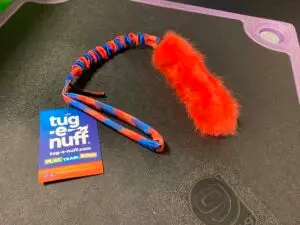
We used to make our own, but often needed stronger versions that could withstand intense play, like this one.
While flirt poles are fantastic, they can be cumbersome to use inside the house. And since I often keep high-value toys in my pocket during training sessions… a flirt pole clearly isn’t making the cut.
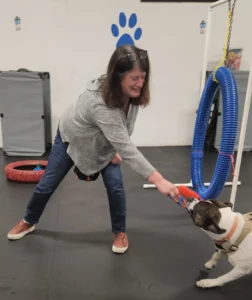 That’s what led me to bungee-style chaser toys. They still allow for prey-like movement, but they’re much easier to use indoors. Unfortunately, many of the versions I tried came apart quickly — I found myself replacing them almost monthly.
That changed when I found Tug-E-Nuff’s chaser toys.
I bought a Faux Fur Squeaky Bungee Chaser over a year ago, and it’s still going strong. This toy gets a lot of use — with my own dogs and in my classes — and it consistently holds up.
More importantly, it never fails to get dogs engaged.
A quick training note: the key is to move the toy like prey. I often joke, “What would a squirrel do?” And just as important: you need to let your dog win occasionally. If they never get the toy, frustration builds quickly.
My Favorite Ways to Use This Toy
For mouthing puppies
If your dog likes to chase and nip at your feet or pant legs when you walk around the house, this is a game-changer. That behavior is usually playful, and simply saying “no” rarely stops it. Instead, drag this toy alongside your feet as you move. It becomes a much more appealing target, preventing the unwanted behavior while building a positive new play routine.
Teaching impulse control
This toy is also an excellent way to introduce impulse control without killing the fun. You can work on waiting, release cues, and self-control while still giving your dog both mental and physical exercise.
I often reference this video where Victory Stillwell is working with a flirt pole — but in practice, I use Tug-E-Nuff chaser toys even more often because they’re easier to handle in real-life settings.
Favorite #2: The Clam Ball

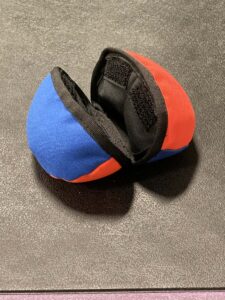
This toy has helped me build interest in toys with dogs who previously didn’t care about them, or simply didn’t know how to play with them. Opening up a dog’s interest in toys can expand their world in so many ways.
At first glance, the Clam is a soft ball. But it opens (like a clam, of course), allowing you to hide treats inside. That simple design detail makes it especially appealing to food-motivated dogs and to dogs new to toy play.
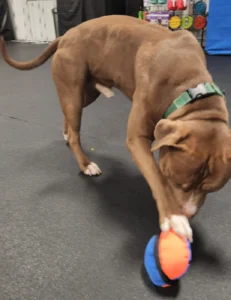 I keep the game very easy at the beginning. In one clip, I even use a large treat and make it visible. Once the dog realizes that this toy reliably holds “treasure,” we can start to tuck the treat fully inside.
When the dog understands the game, they’re more likely to seek out the ball and figure out how to open it. This allows them to practice two very natural behaviors: the hunt and the dissection.
I play hide-and-seek with toys all the time with my Labrador. She’ll happily search out any toy, and it’s one of the best ways I know to help take the edge off mentally and emotionally.
My greyhound, on the other hand, wasn’t naturally inclined to scent out a typical toy. The Clam Ball gave us a way to build a similar game by pairing scent work with food, which made the activity far more motivating for him.
How I Built the Game
I started by letting a treat hang slightly out of the toy. I wanted to pair the cue “find it” with success, so I said the cue and placed the toy directly in front of him.
After a few sessions, I began prompting him and tossing the toy a short distance. The toy was still visible, but because he already understood that there was a treat inside, he was much more likely to follow it.
As his confidence grew, he started moving faster — and with that adorable little spring in his step that tells you a dog is genuinely enjoying the game.
From there, I began tossing the toy out of sight. He would run to the general area and then use his nose to locate it. At this point, the food reward naturally encouraged scenting and problem-solving.
Eventually, I’ll build up to fully hiding the toy and cueing “find it.” Because food is involved, he’s far more likely to use his nose — and once that behavior is established, it often carries over into toy play more generally.
My Potential New Favorite: Clam Ball on a Bungee
Full transparency: I don’t have this one yet — but the moment I saw it, I added it to my wish list.
This toy combines two of my favorite tools from above into one: the Clam Ball and a bungee-style chaser. From a training perspective, that combination makes a lot of sense.
For dogs who don’t naturally chase or tug, this could change that. The bungee allows you to create prey-like motion while keeping the game interactive and dynamic. For dogs who already enjoy the Clam Ball, this adds a new layer of excitement and engagement.
I can see this being especially useful for dogs who need help building toy drive or who benefit from an outlet that blends mental engagement with physical movement. It’s another way to interact with your dog in a way that feels purposeful — not chaotic — while giving them a healthy outlet for energy.
Once this one joins my training bag, I’ll be curious to see how it compares to the other chaser toys I already use regularly. On paper, though, it checks a lot of boxes.
Another reason to visit the website
Beyond offering some of my favorite toys, Tug-E-Nuff also has a solid collection of educational resources on their website focused on the value of play — something I think is widely undervalued.
We often recognize play as a way for dogs to burn off energy, but its benefits go much deeper than that. Thoughtful play can help build confidence, improve resilience, and strengthen the relationship between you and your dog.
Once you have these toys, their website offers helpful ideas for getting more out of them. You’ll find suggestions for using play not just as a fun activity, but as part of your training — because, in my experience, play and training really shouldn’t be separate most of the time.
In Conclusion
So yes — I may be a little late with my Christmas gift suggestions. But the truth is, these toys have so many practical uses that they easily carry over into the new year. If you’re setting New Year’s goals around better engagement, more focus, or more meaningful play with your dog, these tools can help support that.
If you’re looking for dog toys that do more than just tire your dog out — toys that build engagement, confidence, and connection — Tug-E-Nuff is a brand I genuinely trust and use in my own training sessions.
If you’d like to give them a try, you can use The Distracted Dog Lover affiliate link to receive 10% off your purchase.
Please note: This post may include affiliate links. If you make a purchase through these links, I may earn a commission, at no additional cost to you.