

 It happened to me just this morning—decision paralysis.
I had what should have been a simple decision to make for a community theatre production I’m working on (where I spend my time when I’m not training dogs)
It seemed like a small choice, yet without it, I couldn’t announce the event I am working on. It’s a holiday event, and with the calendar already inching toward November, getting the word out now is crucial to its success.
The urgency of the matter made the decision even worse.
My ADHD brain was in full overload mode—too many thoughts competing for attention, too many “what ifs.” When I looked at my two options, my brain saw the value in both, and that made picking one feel impossible.
The ADHD brain struggles because it always wants to make the right choice. The choice that gives us immediate reward. And this is true whether we’re talking about work, theatre, or our dog training plans.
And that got me thinking… how often does this happen to dog owners during training? How do we guide both humans and dogs through those moments of executive dysfunction—when motivation crashes, decisions feel heavy, or progress stalls
How Dog Parents Get Stuck in Decision Paralysis
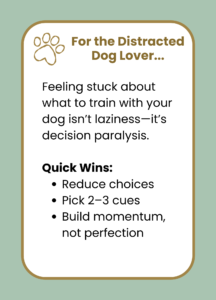
Executive dysfunction can hit dog parents hard. With so many skills we want our dogs to know, it’s easy to get stuck wondering where to start.
So we turn to the internet for answers — and suddenly we’re drowning in advice. Every trainer seems to have a different opinion, and if most of them sound reasonable, an ADHD dog parent can quickly feel buried under a mountain of “shoulds.”
That’s when the decision paralysis hits.
This isn’t laziness — it’s an overload response.
When you can’t prioritize all those training options, your brain interprets it as danger. The stress response kicks in, releasing cortisol and adrenaline, and your problem-solving abilities go offline. Instead of planning your next session, you might find yourself doomscrolling or reorganizing your treat pouch — anything but deciding what to train.
How To Decide What To Train With Your Dog This Week
 First things first — take three deep breaths and remind yourself:
“I don’t have to train everything right away.”
You’re going to focus on just two to three cues this week. That’s it. Simple and doable.
And here’s the key — you’re choosing the cues that matter most to you, not what a well-meaning friend or random TikTok trainer says you should be working on.
Think about what would actually make your day-to-day life with your dog easier or calmer.
- Do you need your dog to sit at the door before guests come in?
- Would it help if they could settle on a mat while you eat dinner?
- Maybe you’d just love a fun trick, like a shake, to help the kids engage.
It doesn’t matter which cues you pick — what matters is that they fit your picture of success.
For your first week, try this simple approach:
- Choose one cue your dog already knows well (for confidence).
- Choose one cue that needs more practice (for growth).
As the week goes on, you might notice new skills suddenly feel more important — and that’s okay! They’ll be waiting for you next week. This process isn’t about doing everything at once; it’s about building momentum and keeping training manageable for both of you.
Staying on Track
Once you’ve picked your focus cues, write them down.
Then, start tracking when you have a training session. Seeing your progress visually is incredibly motivating — especially on those days when your brain insists you haven’t done “enough.”
If you need a visual guide to help with this, I created the Mindful Training Focus Planner, available in my Etsy shop. It was designed specifically for those of us with an ADHD thought process — simple, encouraging, and easy to stick with.
You’ll commit to short, achievable sessions — no more than five minutes at a time.
Set a timer (because ADHD time blindness is real!). Keeping sessions short makes them easier to start and finish — no dread, no guilt, just forward momentum.
This also helps with that all-too-familiar moment at the end of the day when you think, “Oh no, I forgot to train today.”
When you believe training has to be a 20-minute production, you’ll probably skip it. But if your mindset is, “All I need is one minute,” you’re more likely to do it.
The planner also includes space for real-life training scenarios, which help you fit practice naturally into your routine. For example, if you’re working on “settle on a mat,” pair it with commercial breaks during your favorite show. That way, training becomes part of life — not another to-do list item. Over time, you’ll discover which real-world moments work best and turn into habits that stick.
Whether you use my planner or simply jot cues down on paper, put your plan somewhere visible — like the fridge or next to your dog’s leash. A quick visual reminder can help you stay on track even when the day gets busy.
Closing: Motivation to Move Forward
I finally made a decision about my production this morning — and here’s the magic part: I still don’t know if it was the right decision. But the moment I committed, things started moving forward.
Progress, not perfection!
The same thing applies to dog training. When you simplify your process and focus on just 2–3 cues each week, you create space for momentum. If you realize later that your priorities shift, no problem — you’ll simply pivot next week.
That forward motion builds confidence. And remember, small steps still count as progress.
Here’s how to set yourself up for focus and flow in your training:
Reduce choices: Pick 2–3 cues to focus on. This keeps your brain from bouncing between too many goals.
Create visual reminders: Use my planning sheet (or just jot it down!) so you can see what you’re working on and celebrate your progress. Post it somewhere you’ll actually see it.
Add time boundaries: Train for 1–5 minutes. Short, focused sessions fit your day — and a timer keeps you from accidentally training through dinner (ask me how I know).
Connect it to emotion: When you’re unsure where to start, ask yourself, “Which choice helps me feel closer to my end goal?” Emotion-based decisions spark more motivation than logic alone.