
 This week, our goal is to build better walking skills by training a dog who wants to stay close to you.
I call this magnetizing the position.
When you train a dog to want to stay near you, building attention on walks becomes easier — and far less frustrating. Instead of constantly reminding, correcting, or tightening the leash, your dog begins to choose connection.
And if you’ve ever felt like everything on a walk is more interesting than you are, you’re not alone.
Most of us respond by shortening the leash and trying to physically keep our dog beside us. That may “work” in the moment — but you can usually feel the frustration building on both ends of the leash.
Attention Comes Before Walking
Before we can expect great loose-leash walking, we have to teach a new habit:
Staying near you is valuable.
When your dog prefers to be close to you, you don’t need to convince, bribe, or punish them. The value already exists.
Dogs that naturally enjoy engaging with their people are often easier to work with around distractions — when that engagement is built correctly. That’s exactly what we’re doing here.
In our last lesson, the goal was to condition calmness in the presence of the leash. If that exercise still feels shaky, that’s okay. You can continue practicing it separately without the leash, then combine the two skills once the behavior feels solid.
This week’s exercises build the decisions that make loose leash walking easier, including:
- Voluntary check-ins
- Value for being near you
- Choosing connection without cues
These are the kinds of habits that create behavior you don’t have to constantly ask for — and they make walks more relaxing for both you and your dog.
The Benefit of Building Habits Instead of Obedience Cues
There is absolutely a place for both habits and obedience skills. But most dog handlers focus almost exclusively on obedience — and that’s not accidental.
Obedience feels safer because it’s familiar.
It’s also easier to measure.
A sit is clear. A down is clear.
Attention? That’s more subjective.
Obedience gives us a sense of control, while habits influence behavior more subtly — so it’s natural that obedience feels more comfortable.
But when we intentionally build healthy habits, we don’t just get better behavior — we also support our obedience training.
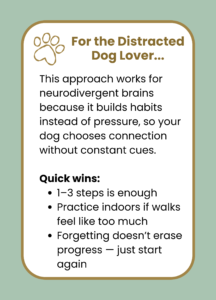
Those of us who are neurodivergent, distracted, or simply busy already understand the power of habits. The same principles apply to dog behavior:
- Habits reduce cognitive load for both dog and human. Once a habit is formed, your dog doesn’t have to “decide” — and you don’t have to remember to cue.
- Habits are more resilient under stress.
Obedience relies on working memory, which becomes harder to access under stress. Habits live in procedural memory, which is far more reliable when emotions run high.
Because habits are harder to measure, they can feel harder to build — but that’s exactly why these games exist. I’m here to guide you through that process.
Let’s Tie This Back to Building Attention on Walks
This week, the habit we’re focusing on is your dog choosing to stay connected.
When your dog is connected, you don’t need to constantly cue. Instead, your dog checks in voluntarily.
Be sure to revisit the games from the first article in this series. Now, we’re taking that connection and bringing it into motion.
Training Game: Magnet Hand
While we do want to teach our dogs where to walk, teaching them to target our hand builds strong value for being in that position.
Set-Up
- Indoors, low-distraction environment
- Treats in the hand at your side (where you want your dog to be)
The Game
The First Few Session
- Start with your dog on the side you’d like them to walk.
- Lift the hand (on the same side as your dog) with several treats over your dog’s head.
- Repeat several times.
After A Few Sessions
- Start with the dog in walking position and your hand over their head.
- Take a step, drop a treat
- Vary the direction that you take your steps, so your dog learns to focus on your movement.
“Touch” Alternative
If your dog already knows a nose-target (“touch”), you can use that cue here. See how to teach it here.
- With your hand at your side, ask for a touch
- Mark and reward
- Take one step
- As you move, bring your hand back to your side and ask for another touch
- Gradually build up to 1–3 steps before reinforcing
Pause between repetitions.
That pause matters.
Stillness gives your dog time to process what worked — and it gives you a moment to reflect on what you’re reinforcing.
You are not reinforcing staring or perfect heel position.
You are reinforcing choosing to stay near you and match your movement.
Short reps are intentional. Longer stretches increase frustration, rushing, or grabby behavior. Short reps also keep the rate of reinforcement high — which is exactly how habits form.
Troubleshooting Common Concerns
“My dog is just following the food.”
Yes — at first. Food builds value. With repetition, the value shifts from the food to the position and the shared movement.
“My dog gets grabby or frustrated.”
That’s useful information. This often shows up across training, not just here. I recommend addressing treat delivery mechanics first, then returning to this exercise. Watch this video for help with this.
“They can do this inside, but not outside.”
Totally normal. Magnet Hand is a foundation skill, not a finished behavior. We’ll layer distractions gradually.
How This Transfers to Walks
Magnet Hand conditions your dog to stay engaged with you while in motion.
When combined with the exercises from our Focus While Walking article, your dog learns that attention pays — in many environments, not just one.
As your dog progresses, you’ll:
- Increase step
- Add changes in pace
- Add direction changes
Your dog learns that no matter what you’re doing, staying connected to you is rewarding.
This game also gives you a gentle way to help your dog refocus when distractions pop up — without leash pressure or frustration.
In conclusion
The goal of this game is not to hold your dog’s attention.
The goal is to build value for staying near you — and to make it easy for your dog to come back to you.
Throughout the week, challenge yourself to notice those moments of voluntary check-ins. Reinforce them with praise, toys, or treats.
Building habits can feel slower than teaching obedience — but in the long run, these habits are what make obedience possible.
And that’s how we build attention on walks that last