
 The beginning of a new year often inspires us to start fresh—new projects, new routines, new habits. For many dog owners, one of the first things on that list is loose leash walking.
And honestly? I get it.
No one enjoys being yanked down the street. Walking your dog shouldn’t leave your shoulders sore or your patience worn thin. A walk should feel like time spent together—not a test of strength or sanity.
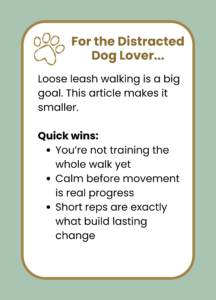
But here’s the problem: loose leash walking is a big goal. When we look at it all at once, it can feel overwhelming—like standing at the base of a mountain and wondering where to even start.
The good news? We don’t climb the mountain all at once. We break it into small, manageable steps.
Loose Leash Walking Is Built From Habits, Not Willpower
If you’ve read my article Why New Year’s Resolutions Don’t Work, you already know I’m not a fan of big promises that set us up to fail.
Loose leash walking isn’t a single behavior.
It’s the result of many small, repeated choices—by both you and your dog.
When we focus only on the end goal (“My dog should stop pulling”), we miss the habits that actually get us there. This article is about identifying those habits and practicing them in a way that’s realistic, sustainable, and kinder to everyone involved.
Why Dogs Pull on Leash (And Why It’s Not Personal)
The first thing we need to acknowledge is this:
Loose leash walking is a human idea.
Walking calmly beside someone is not a natural behavior for dogs. Most dogs prefer to trot, explore, sniff, and move faster than we do.
- Average dog’s natural pace: 3.5–4.5 mph
- Average human’s walking pace: 2.5–3 mph
When we ask dogs to walk on a loose leash, we’re asking them to slow down, ignore interesting scents, and match our rhythm.
Try this experiment: walk to another room at your normal pace. Now walk back at half that speed. It’s possible—but you probably had to think about it.
Dogs have to do that thinking, too.
Add to that the fact that dogs experience the world primarily through scent and movement. Interrupting a dog mid-sniff is a bit like someone changing the channel while you’re in the middle of a show. That doesn’t make them stubborn—it makes them engaged.
None of this means dogs can’t learn loose leash walking.
It simply explains why we need to teach it thoughtfully.
What Loose Leash Walking Actually Means
One of the most significant sources of stress I see is the belief that a dog must walk in perfect heel.
They don’t.
A heel—where your dog’s shoulder lines up with your leg, and their attention stays on you—is a formal behavior. My dogs know it, but I only use it briefly in busy or high-risk environments.
For everyday walks, my criteria are simple:
- The leash stays loose
- If I say my dog’s name, they can give me attention
That’s it.
Loose leash walking allows dogs to sniff, explore, and move naturally. In fact, letting dogs engage with their environment is mentally enriching and often more tiring than constant motion.
Why Loose Leash Walking Starts Indoors
If you were teaching a child to read, you wouldn’t start in the middle of a theme park.
You’d start somewhere quiet, predictable, and supportive—then gradually increase difficulty.
Dog training works the same way.
Indoors, there are fewer distractions. You can focus on your timing, your leash handling, and your dog’s emotional state. Indoor training isn’t a shortcut—it’s strategic.
Calm skills are much easier to build before adding the environment.
Building Stillness Before Movement
Before we ever take a step, we need to teach calm at the start of the walk.
If your dog becomes overexcited the moment they see the leash, that emotional state will carry straight out the door. This week, we focus on calm leash handling without movement.
Set-Up:
- Indoors, real-life environment
- Your dog
- High-value, easy-to-deliver treats
- A leash placed nearby
How the Exercise Works
Do not do all of these steps in one session.
- When your dog calmly looks at the leash, mark (“yes” or click) and treat
- Place your hand on the leash → mark and treat for calm
- Pick up the leash → mark and treat for calm
- Clip the leash on → mark and treat
- Unclip the leash → mark and treat
No walking happens yet. Calm is the goal.
What “Calm” Might Look Like
For each dog, this might look different. Here are some ideas of what to reinforce
Calm looks different for every dog. You might reinforce:
- brief pauses
- softer body language
- offered eye contact
- quicker recovery from excitement
Small moments count—especially in the beginning.
How to Practice (Keep It Sustainable)
Time:
1–2 minutes per session
Frequency:
2–3 short practices per day
Environment:
Indoors, low distraction
End the session before frustration shows up—success builds motivation.
Troubleshooting Common Concerns
“My dog gets too excited.”
That’s information. Make it easier. Place the leash farther away or lift it only an inch at first.
“This feels too easy.”
Foundations often do. But the stronger the foundation, the more we’ll be able to build on it.
“We want to walk already.”
If your dog is pulling, they’re telling you they need more coaching. Changing the behavior requires changing the approach.
“Doesn’t my dog need to walk daily to burn energy?”
Walks can be great—but without the proper habits, they can also lead to stress and bad habits. If your dog needs outlets, consider:
- Playtime. My favorite way to burn energy is with a flirt pole. It is a great interactive toy for you and your dog that most dogs love. This is the brand I use.
- Nosework. Giving your dog outlets for sniffing has so many benefits. And since letting my dogs sniff is half the reason I walk them, when I can’t, I bring the scents to them! Read this article to get started.
- Off-Leash Play. If you don’t have a fenced area, I highly recommend renting a fenced yard through SniffSpot a few times a month.
Supporting Games For This Week
If you worked on the focus exercises I posted last month, this part will likely go faster. If you haven’t, don’t fear! It is never too late to build better focus!
And training will also help burn some of that energy you were hoping a walk would burn!
You can find them here:
Week 1: Micro Training and the Name Game
Week 2: Focus Amidst Distraction
Week 3: Building Calm to Help Your Dog Focus
Week 4: Proofing Your Dog’s Focus
Week 5: Building Focus While Walking
Stronger attention makes loose leash walking easier.
Habit Stacking for Loose Leash Walking
One of the benefits of starting indoors is that you can pair training with habits you already have.
Keep your leash near the coffee pot. Practice calm with the leash while your coffee brews—pair focus games with brushing your teeth.
Habit stacking makes consistency easier—and consistency is what builds lasting change.
For more information about how to habit stack, read the article here.
In Conclusion
Loose leash walking doesn’t improve because we want it to.
It improves because we build habits that support it.
When you break the skill into small pieces and practice them intentionally, walks become calmer, more connected, and far more enjoyable.
Think of these as your pre–loose leash walking skills.
This is how real change starts.
Please note: This post may include affiliate links. If you make a purchase through these links, I may earn a commission, at no additional cost to you. Thank you for helping keep this blog running!