
Like many dog owners, I’ve been there. Determined to stay consistent with my dog training sessions and do a little every day. And honestly? I usually start strong, training two days in a row!
Then suddenly, the week slips by before I even remember that third session. By the time I get back to the skill I was working on, I’m retracing earlier steps instead of moving forward.
Luckily, my dogs are quick learners. But every time they remind me how fast they learn, I can’t help but wonder how much further we’d be if I were just a little more consistent.
Part of this, for me, comes with being a neurodivergent dog owner — but I’ve realized I’m not alone. In conversations with clients and friends, it’s clear that even neurotypical dog owners struggle with consistency. Life is busy, distractions happen, and training often slides to the bottom of the list.
The truth is, dog training works best when it’s consistent — small, regular sessions that become part of your everyday life. So how do we build training habits that actually stick?
That’s a question I’m always trying to solve. And during a recent conversation with ADHD coach, author, and podcast host Tracy Otsuka (for my article Neurodivergent Dog Owner Tips for Success), she mentioned something that caught my attention: habit stacking.
I was intrigued — and decided to take a deep dive into how this simple idea could transform the way we approach dog training.
What is Habit Stacking?
Habit stacking is simply attaching a new behavior to an existing habit you already do every day.
“If I wait until I feel motivated to do anything consistently, I’ll be waiting forever,” shares Otsuka. “The trick is to build it into the flow of your day. They call it habit stacking which means you’re adding something new to a habit you’ve already developed. Training your dog while your coffee’s brewing or while you’re brushing your teeth totally counts.”
And she’s right! It counts. In fact, I’d argue it’s even better than a planned training session. I’m always telling my students to keep their sessions short, but people tend to overdo it. Quick, natural sessions fit more easily into everyday life and prevent burnout for both you and your dog.
When we pair dog training with our daily activities, we’re also teaching our dogs to respond to cues in real-life scenarios, the places where those skills matter most.
The term “habit stacking” was first introduced by James Clear in his book Atomic Habits: An Easy & Proven Way to Build Good Habits & Break Bad Ones. When we connect a new behavior to an existing routine, it takes far less mental energy to remember—whether it’s training the dog, taking a vitamin, or starting a gratitude practice.
This made so much sense to me. If you, like me, want a deeper dive, you can read more here.
Why Habit Stacking is Especially Useful for Dog Training
I really love so many things about this concept. As I mentioned above, it keeps dog training sessions short, natural, and rooted in real-life situations, which is exactly where your dog needs those skills most.
For us humans, habit stacking is a game-changer. We don’t have to carve out extra time in our busy schedules or remember to “plan” a training session. Instead, training becomes something we do automatically, right alongside our morning coffee or evening walk.
By turning dog training into a routine habit, we also take the pressure off ourselves. It feels less like a chore and more like part of our daily rhythm. That shift alone can dramatically reduce frustration and make consistency feel effortless.
How to Get Started
Getting started with habit stacking is simple. You’ll pair something you already do without fail—a daily habit—with the new habit you want to build.
James Clear, author of Atomic Habits, recommends writing it out as a simple formula: “After/Before [CURRENT HABIT], I will [NEW HABIT].”
For dog training, it might look like this:
“After I make the coffee, I’ll practice my dog’s sit cue.”
“Before I grab a snack, I’ll practice leave it twice with my dog.”
Start by listing your regular daily habits, then write down the training behaviors you’d like to strengthen. Pair one everyday habit with one training behavior.
Clear notes that the secret to success lies in choosing the right equation. If you try to practice a down-stay while making dinner—but end up burning your meal in the process—it’s time to adjust.
“Consider when you are most likely to be successful,” Clear advises on his website. “Don’t ask yourself to do a habit when you’re already occupied with something else.”
That’s great advice for both humans and dogs. Start small—just one new habit at a time. Especially for my fellow neurodivergent dog owners, it’s easy to get excited and want to change everything at once. But consistency grows best when you build slowly. You can always add more in a few weeks.
Visual Cues: Habit Stacking Dog Training Cards
 Visual cues are powerful tools for remembering the new habits you’re trying to stack. Many of us—especially neurodivergent dog owners—benefit from seeing tangible reminders that say, “Oh, right! When I brew the coffee, I also practice sits with the dog.”
You can absolutely start with sticky notes or good old-fashioned paper and tape!
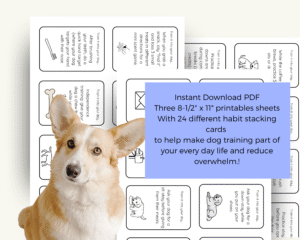
But if you’re like me, sometimes the planning takes longer than the doing. I kept meaning to make my own reminder notes for weeks… and never quite got around to it. That’s why I created my Habit Stacking Dog Training Cards—to eliminate that hurdle and help you start right away.
These printable cards make it easy to find inspiration for everyday moments where you can build in short, fun training sessions. Just print, cut, and post them where you’ll see them while doing the task you’ve paired with your training exercise.
Troubleshooting & Tips
When You Forget or Skip
You’re human. It happens. Life happens. The key is to pick it back up without beating yourself up. If you only remember half the week, that still means your dog got three or four training sessions! That’s so much better than zero. Consistency isn’t about perfection; it’s about persistence.
Setting Yourself Up for Success
Be honest about where your dog’s training is right now and choose realistic behaviors to pair with your habits. For example, if your dog still likes to grab at clothing, don’t start with a down-stay while you fold laundry—that’s too distracting too soon. Instead, begin with something simpler, like a down-stay while you make toast.
Start easy, then grow from there. Small wins build momentum and confidence for both ends of the leash.
How to Level Up Your Habit Stacks
As your dog becomes more skilled, you can gradually increase the challenge. Let’s go back to the down-stay example: once your dog can stay calmly during your toast-making routine, try adding mild distractions—like practicing during dusting or while tidying the room.
Think about what typically distracts your dog most and work up to those situations gradually. The goal is to make real-life reliability feel natural and fun for both of you.
In Conclusion
Consistency matters far more than long, formal training sessions. Habit stacking is one of the simplest ways to train yourself to weave dog training into everyday life.
This week, I challenge you to choose just one habit to stack. Start small, stay curious, and notice how quickly those little moments add up.
If you’re not sure where to start, check out my Habit Stacking Dog Training Cards—they make it easy to spot those perfect “in-between” moments and turn them into quick, meaningful training sessions.
My first habit stack actually combined a household task with a dog care routine. I never forget to feed my dogs breakfast (they wouldn’t let me!), so I paired it with making my bed. Now, it’s something I do almost every morning—proof that small habits can shift everything.
I’d love to hear how it goes for you! Share your favorite habit stacks or what’s worked for you in the comments below, or tag me on Facebook or Instagram so we can celebrate those wins together.
Please note: This post may include affiliate links. If you make a purchase through these links, I may earn a commission, at no additional cost to you. Thank you for helping keep this blog running!