
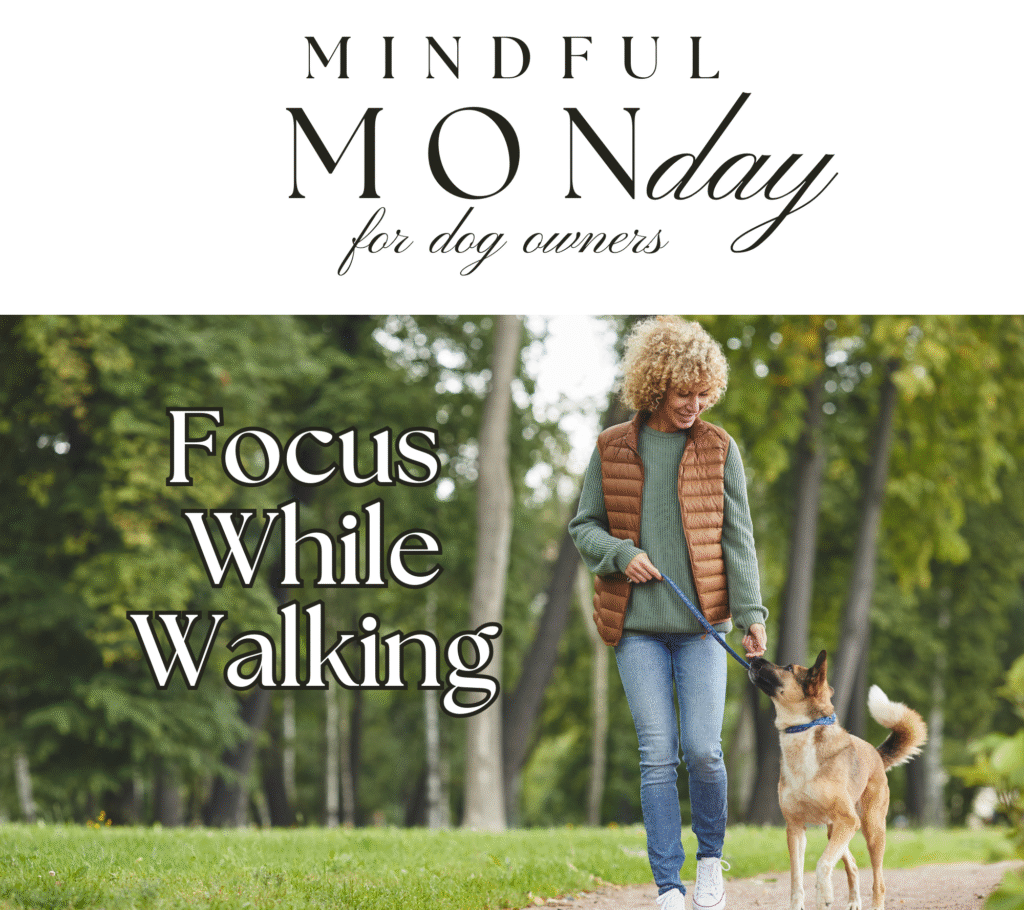
 If you’ve been working through the exercises outlined in the first four weeks of our Exercises for Focus series, you’re probably starting to notice real changes — calmer behavior, quicker check-ins, and more intentional engagement.
But then you start walking… and suddenly it feels like all that focus disappears.
If your dog’s focus isn’t carrying over while walking, that’s completely normal.
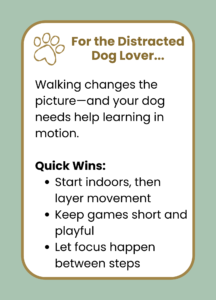
Adding motion changes the picture for your dog. And when the picture looks different, we have to help our dogs learn that the expectation for focus hasn’t gone away — it has simply moved with us.
This is where dog focus while walking begins to take shape.
One of the biggest benefits of this stage is that we’re no longer asking for forced attention. Instead, we’re conditioning a dog who wants to offer focus. That willingness makes everything easier — especially loose-leash walking and navigating distracting, real-life environments.
This week, our goals are to teach your dog that:
- Focus doesn’t disappear just because we’re walking
- Checking in can happen between steps
- Calm attention matters more than perfect position
This is not about teaching a formal heel.
It’s about building connected movement that actually works in the real world — busy sidewalks, holiday chaos, and everyday walks with a distracted human on the other end of the leash.
Using Training Games to Build Your Dog’s Focus While Walking
Pick the one that sounds like the most fun.
That’s it.
When you enjoy the game, you’re far more likely to come back and play it again tomorrow. Those short, consistent moments matter more than long, perfectly executed sessions. Over time, they help your dog understand that offering focus is valuable, not just something that happens when a cue is given.
Our goal here is to make focus a default behavior, not an obedience response your dog performs only when asked.
Where to Start
- Begin these games indoors, where distractions are low.
- Once your dog is easily offering focus, move to a familiar outdoor space.
- From there, you can gradually introduce more real-world environments.
This layered approach helps your dog succeed while learning that attention carries over — even when the picture changes.
Game 1: The 1-Step Attention Walk
A micro-exercise that builds attention one step at a time.
This simple game is designed to help your dog practice focus while walking without pressure, drilling, or formal positioning. One step is enough.
How to Play
- Stand still with your dog on leash.
- Take one single step forward.
- Pause briefly.
If your dog glances at you
(eye contact or even a small head turn — your dog does not need to step with you):
- Mark (yes or click)
- Reward
- Take another step
If your dog does not check in:
- Stop
- Reset calmly
- Try again
That’s it. No pressure. No drilling.
Troubleshooting:
If your dog isn’t engaging, pause and evaluate the situation:
- Is the environment too distracting?
- Is your dog mentally or physically tired?
These are signs that we need to change when or where we start this exercise, not push through it. Focus while walking has to be built gradually. The foundation always comes first — movement and distractions come later.
Game 2: Beginner Pattern Games
Canine behaviorist Leslie McDevitt developed pattern games, which are widely used because they build attention quickly and reliably. Dogs naturally love patterns. When we weave predictable patterns into training, we create a sense of safety and clarity — and that leads to strong, voluntary focus.
Pattern games are especially helpful for dogs who feel overwhelmed or easily distracted, making them a great fit for building dog focus while walking.
Up Down Game
Before we add movement, we first teach the foundational pattern. This gives your dog something familiar to return to once walking is introduced.
How to Play
- Place a treat on the ground.
- Let your dog eat the treat.
- When your dog looks up at you:
- Mark (yes or click)
- Deliver the next treat to the ground, bringing you back to step one
- Repeat
That simple up–down rhythm is the pattern.
If you need a visual guide, check out this super short video.
Why This Game Works
- Predictability lowers arousal
- The pattern encourages natural check-ins
- Focus becomes a habit, not a command
- Your dog learns that engagement keeps the game going
Once this pattern is fluent, it becomes a powerful tool you can carry into movement and walking exercises.
Troubleshooting
If your dog isn’t checking in:
- They may be too overstimulated
- The environment may be too distracting
- The reward value may be too low
Try:
- Moving to a quieter space
- Using higher-value treats
- Slowing the pace and reinforcing the pattern first
If the pattern isn’t solid yet, that’s your cue to simplify — not to push forward. We always want to build the foundation before adding movement or distractions.
Mini Super Bowl Games.
If you look this game up online, you’ll often see examples using four or more bowls. And yes — you’ll get there.
But for now, we’re going to start smaller and simpler so your dog can succeed.
How to Set It Up
- Place two bowls about one foot apart (or even closer).
- Place a treat in the first bowl and let your dog eat it.
- If you’ve built a solid Up–Down Game, your dog will naturally look up at you.
- When your dog looks up:
- Mark (yes or click)
- Move to the second bowl
- Place the earned treat in that bowl
- Repeat, moving back and forth between the bowls.
This simple setup helps build dog focus while you are moving, without overwhelming your dog or adding unnecessary complexity.
Why This Game Works
- Your dog learns to track your movement
- Focus is reinforced between transitions
- Motion becomes predictable instead of exciting or chaotic
- Attention stays connected, even as you change location
As your dog becomes more successful:
- Gradually move the bowls farther apart
- Then begin adding additional bowls one at a time
Let success guide the pace.
Seeing the Game in Action
If you’d like a visual example, check out this video.
You’ll notice the handler:
- Warms the dog up with a few reps of the Up–Down Game at the first bowl
- Waits until the dog is focused
- Then smoothly transitions into the Super Bowl pattern
That warm-up matters — it sets your dog up to win.
Want to Go Deeper? Recommended Reading
If you find yourself loving these games (and they do tend to become addictive), I highly recommend the Control Unleashed book series by Leslie McDevitt.
Control Unleashed: Creating a Focused and Confident Dog
This was the first book in the series that I read. While many of the exercises were originally designed to help reactive dogs build focus in sport environments, the concepts translate beautifully to everyday life. These games are excellent for any dog that needs help offering attention.
Control Unleashed: The Puppy Program
After reading the first book, I remember thinking, “How great would it be to teach these games to puppies from the very beginning?” So I like to think I helped manifest this one. While it’s geared toward sports foundations, the focus skills it builds are incredibly valuable for puppies—and their humans.
Control Unleashed Reactive To Relaxed
In this book, Leslie introduces additional tools to help reactive dogs — and their handlers — develop better coping skills. It’s especially helpful for frustrated owners who love their dogs but aren’t sure how to help them navigate big feelings.
Game 3: Choose to Heel
I can already hear you saying,
“I thought you said this wasn’t about teaching a formal heel!”
And you’re right — it’s not.
This game has been part of my training toolbox for about 25 years, dating back to a time when “heel” was the default goal for everything. The name stuck, but the intention has changed.
The goal here is simple: capture offered attention when your dog walks near you.
How to Play
- With treats in a food pouch, bring your dog into a small, low-distraction room.
- Begin walking slowly in a loose circle around the space.
- Observe what your dog does:
- If they simply watch you, that’s fine.
- If they choose to walk near you, quietly praise them.
- While you are both moving, if your dog looks at you:
- Mark (yes or click)
- Reward
That’s it.
You’re not cueing anything. You’re capturing moments of attention as they naturally occur. Over time, those moments increase — because attention works.
What This Game Builds
- Voluntary focus while walking
- Awareness of your movement
- Calm connection without control
- A walking partnership rather than a position
This is how dog focus while walking becomes a habit instead of a command.
Taking This Game Outside (Safely)
Once your dog is choosing to walk near you with consistent focus indoors, it’s time to change the picture.
Because safety matters, this game should be practiced in a fully fenced area.
If you don’t have access to one, here’s a fun and practical alternative:
Enrich & Learn Outing
Check out Sniffspot, a site where you can rent a fully fenced yard as your dog’s own private dog park by the hour.
How to set this up for success:
- Choose a listing that clearly states it is fully fenced
- When you arrive, give your dog at least 15 minutes to sniff and explore
- This sniffing time is valuable enrichment and helps lower arousal
- Once your dog has settled, begin walking casually around the space
- Each time your dog checks in with you:
- Mark and reward
Bring high-value treats, especially if your dog is still new to working outdoors or easily distracted by novel environments.
Trainer Tips
For the best results:
- Start in a low-distraction environment.
If your dog isn’t interested in checking in with you, they’re likely too distracted. That’s not a failure — it’s information. Build a strong foundation of focus before adding distractions. - Keep games short.
Begin with 1–2 minute sessions. As your dog becomes more comfortable with the games, you can gradually increase the duration. Short, successful sessions beat long, frustrating ones every time. - Capture even brief moments of focus.
Early on, a quick glance or head turn counts. Expecting too much too soon can frustrate both you and your dog — and slow progress instead of speeding it up. - Reset when you change environments.
When training in a new place, return to the simplest version of the game and build up from there. New environments always change the picture, and your dog deserves the chance to succeed there, too.
In Conclusion
I hope you’ve had fun building focus and connection with your dog over these last five weeks. These exercises are meant to be returned to again and again, so feel free to bookmark this series and revisit the lessons whenever you want to strengthen your dog’s attention — or reconnect after a busy season.
By building attention in a variety of ways, you’re helping your dog understand that focus can happen in many different contexts, not just in one specific training setup. And when attention comes first, everything else becomes easier — walking, learning new skills, and navigating real-life distractions together.
Focus isn’t about control.
It’s about connection.
Read more in the Focus Series:
Week 1: Building Focus
Week 2: Focus Amid Distraction
Week 3: Building Calm
Week 4: Proofing Focus
Please note: This post may include affiliate links. If you make a purchase through these links, I may earn a commission, at no additional cost to you.