

 As someone living with ADHD, I know firsthand that training a dog can feel both rewarding and overwhelming. And I train dogs for a living.
I can hyperfocus on teaching a new skill, brainstorm creative solutions, and deeply connect with my dogs. However, I also know how tough it can be to stay consistent, remember steps, or maintain a routine.
Why is this the case? What types of tricks and tips can neurodivergent dog owners use to help us achieve our dog training goals?
While I may know dogs, I only my own personal real-life experience with my ADHD brain, so I turned to some expert resources to gain a better understanding and build better strategies for me and for you!
What Makes Dog Training Harder for ADHD & Neurodivergent Humans
Can you tell if someone is neurodivergent just by looking at them? I couldn’t even when I looked in the mirror. That’s probably why it was so easy for me to believe I was just lazy. People said it often enough that it stuck, and before long, I started repeating it to myself like a mantra I never asked for.
But a little understanding goes a long way. I always thought that sitting and thinking about different ways to tackle a project instead of actually completing it was just another way to procrastinate. Then I started learning that this is a divergent thinking pattern common with those with ADHD.
And with divergent thinking, possibilities are endless, which can be overwhelming.
Add to that the vivid imagination that fuels anxiety. When that imagination takes over, many of us can come up with every possible bad scenario.
One of my favorite Facebook memes (with a nod to Jay-Z) is “I’ve got 99 problems and 86 of them are completely made-up scenarios in my head that I am stressing about for no absolutely no logical reason,” because I was so good at this.
Realizing I wasn’t just lazy but that my brain works differently lifted a huge weight. Instead of shame, I finally felt hope. ADHD, I learned, is genetic. So blaming myself for scattered thoughts is about as fair as blaming myself for having brown hair.
And I’m not alone. So instead of guessing my way through, what if I actually talked to other people with neurospicy brains to see what worked for them? Sharing tried-and-true strategies put a little method into my madness.
Let’s combine expert insights with dog training skills. Both can teach us a lot about structure, patience, and progress.
Why Traditional Dog Training Advice Often Fails ADHD Brains
I’ve heard it before.
Heck, I’ve even said it to students myself: consistency brings results.
And while that statement isn’t wrong, it often adds pressure instead of support for neurodivergent brains.
Rigid schedules and “do this every day” advice tend to ignore executive dysfunction — the very real challenge of task initiation, follow-through, and emotional regulation that many ADHD dog owners navigate daily.
Then it happens.
A practice session gets missed.
And suddenly guilt creeps in.
That guilt turns into shame, and shame drains the energy and momentum you had been building. What started as a missed day becomes a reason to stop altogether.
If this resonates, I want you to read this twice:
You are not failing.
You are not lazy.
You just need a system that works with your brain — not against it.
ADHD-Friendly Dog Training Principles
There are a few traps the ADHD brain can fall into, and one of the big ones is emotional regulation.
For those of us with ADHD, it can look like getting frustrated quickly, expecting a behavior to click right away, and then struggling to calm down once the frustration sets in. The tricky part is that those reactions can chip away at our relationship with our dogs. Training works best when it’s built on trust, and none of us wants our dogs to feel like they have to guess how we’ll respond to them from moment to moment.
Understanding this can help you give yourself a little grace. If you notice frustration creeping in, it’s completely okay (and likely beneficial) to take a break. Your dog will learn more from two short, positive sessions than from five that are clouded by stress or frustration.
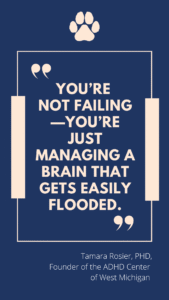 Tamara Rosier, PHD, is the founder of the ADHD Center of West Michigan and author of one of my favorite books, Your Brain’s Not Broken. She also has four dogs.
“Our brains often go from ‘I’ve got this!’ to ‘I’m the worst dog owner ever’ in seconds,” she says. “When that happens, pause and name it. You’re not failing—you’re just managing a brain that gets easily flooded. Take a breath, regroup, and try again later.”
Dog trainers often advise staying consistent with training sessions, and I understand why. But here’s the thing: two good sessions are better than none at all, especially if you’ve been beating yourself up for missing days. Don’t let the shame of inconsistency stop you from trying again.
I reached out to Tracy Otsuka, an ADHD Coach and author of ADHD For Smart Ass Women, as well as the host of one of my favorite podcasts (with the same name as her book), for her tips for the distracted dog lover.
Tracy also has two dogs of her own, so she understands the struggle.
“You’re going to forget. Plan for that,” Otsuka says, “You’re not broken because you forgot to train your dog for three days. That’s just your brain. The key isn’t to be consistent, it’s to recover quickly without shame.”
Giving yourself empathy will help you stay on track. And consistency doesn’t have to be rigid. Please work with your brain, and not against it.
Practical ADHD Dog Training Strategies That Actually Work
 Habit Stacking For Success
A great way to build consistency in your training sessions is by utilizing Habit Stacking.
“If I wait until I feel motivated to do anything consistently, I’ll be waiting forever,” shares Otsuka. “The trick is to build it into the flow of your day. They call it habit stacking which means you’re adding something new to a habit you’ve already developed. Training your dog while your coffee’s brewing or while you’re brushing your teeth totally counts.”
This isn’t just a great way to help someone who’s neurodivergent (or just a little forgetful) remember training sessions—it’s also a simple way to build your dog’s skills right into real-life moments.
Often, people hone their skills in rigid training sessions. Which is great when just beginning a skill, but as the dog becomes more fluent, you want to build your dog’s response in everyday moments.
So, link these quick training sessions to something that is already part of your routine. Here are some suggestions, but adjust these to reflect the skills that are most important to you:
Practice any new skills during tasks that give you a little more time, like when making coffee, tea, or microwaving. Or, when you are watching TV and a commercial comes on.
Getting dressed or putting on your shoes. This is a great time to practice stay in the position of your choice. If your dog likes to get nosy when you are putting on shoes, you might start small by asking for a stay while you put your shoes on.
Take a Break! Teach a settle on a mat or bed. Start this when you are watching TV or reading a book. When your dog starts to get good in this scenario, you can advance to practicing while drinking coffee and eventually while eating meals.
Make Training Visual
Visual reminders can help bring the neurodivergent brain back to the task at hand.
“Don’t rely on memory or willpower,” suggests Rosier. “Post-it notes, visual cues, timers, and pre-set checklists can be game-changers. Something as simple as keeping the leash by the door or setting a training reminder on your phone can make things feel more doable.”
The neurodivergent brain is often prone to overthinking, and our brains are not designed to retain multiple pieces of information simultaneously. So you want to train your dog, but by the time you walk to the kitchen to grab training treats, you start thinking about dinner.
“Set visual cues,” suggests Otsuka. “Sticky notes. A leash on the doorknob. A treat pouch hanging on the fridge. Whatever reminds you to try again.”
One of my training tools also serves as that visual reminder. I set up training stations. These are small, airtight plastic containers filled with treats, placed around the house (out of reach of the dogs). Whenever a training station catches my eye, I ask one of my dogs for a behavior and reward it.
This also solves another problem that often faces the ADHD brain: the task of getting all of our training gear together for a session can overwhelm us. When we’re on overload, we are much more likely to put off a task.
“ADHD brains don’t like friction. If your treats are buried in a cabinet, training won’t happen,” warns Otsuka. “Set up your environment so the next step is obvious. Put stuff where you’ll see it so it reminds you. That way you don’t have to remember or frankly, think.”
Get Habit Stacking printable cards for visual reminders to train your dog.
Sensory-Friendly ADHD Dog Training Tips
Planning a calm training environment when you are first starting your training journey is beneficial for both the neurodivergent pet parent and their dog.
When I teach a new training class, I advise their families to start training in a low-distraction environment and only add distractions as their dog responds consistently.
This is standard for most species. It is why we teach kids to read first in a quiet classroom. We don’t expect them to learn to read at Walt Disney World.
However, this is especially helpful for neurodivergent dog owners. Unexpected distractions not only take our focus but can also create significant frustration. Give yourself the grace to get familiar with the mechanics of training before going to spaces that will distract both of you.
I often compare learning training mechanics to learning choreography. It will get easier as you practice and gain confidence. Then you can start to vary the training environment. Follow your own comfort level.
To help you plan for successful training sessions (including environments where you feel comfortable), I have a free resource available to anyone who signs up for my email list. The printables, including the Ladder of Distraction and the 2-Minute Training Session, can help you plan out successful training sessions.
Give Yourself a Break
The neurodivergent crowd tends to be very hard on themselves. Our ADHD tendencies often lead to guilt.
Guilt will only hinder your dog training plans. Give yourself grace and understanding. It is a fact that ADHD affects executive function. Executive function controls planning, organizing, and following through on tasks.
First, aim for progress over perfection. Perfection is not achievable by anyone.
There are also no errors—just opportunities for more data. For instance, if I bring my dog to a busy park, and I am not getting the response I want, I record that this environment has too many distractions for their current level of training. I write that down (or I will forget it) so I can better plan for our next session.
And don’t set goals based on other people’s advice. Rosier shares that ADHD brains aren’t as motivated by long-term goals as they may be by emotional rewards.
“That’s why ‘I should train the dog’ often leads nowhere, but ‘I want my dog to feel safe with me’ creates traction,” she says. “You love your dog, and your dog counts on you. Let that emotional connection guide your actions.”
So don’t let anyone else’s training goals (even if it’s your instructor) get in the way of your goals. Consider what you hope to gain from training. Is it a better bond with your dog? Is it watching them have fun?
“Try anchoring your training in real, felt moments: the joy of a calm walk, the relief when your dog listens the first time, or the pride in seeing progress (even tiny ones),” says Rosier. “ Use emotion as the spark—not guilt—as your fuel.”
Setting Yourself Up for Success
Being neurodivergent means our brains work differently. But we are not broken. We need to determine which tools work best for us as individuals.
 I used to really hate taking notes during training. It took me out of the moment and could sometimes throw me off course (there’s the ADHD brain again!). So, I made it easier. I made a cute notebook that amused me (which seriously makes me use it more!), and I wrote down what I knew I needed to work on.
Part of my goal with The Distracted Dog Lover is to create tools that help neurodivergent brains work more efficiently with our dogs. This comes from my own drive to avoid frustration.
One thing I noticed while taking videos of my training session is that I didn’t stay consistent with my cues. I may not understand my brain as much as I would like, but I do understand how dogs think. And the lack of consistent cues will only slow down the training progress.
So, I created a cue tracker. Not only is this helpful if you’re forgetful, but I’ve also met many families where each member cues their dog differently (and wonder why their dog only responds to one family member). I have this tool available on my Etsy shop.
Decide what works best for you: notebooks, sticky notes, phone reminders, and alarms can all be helpful tools.
Conclusion: Training That Works for Your Brain and Your Dog
Being neurodivergent doesn’t mean you can’t be an amazing dog owner. It means you need strategies that work with your brain, not against it. ADHD can make consistency, focus, and memory challenging, but small adjustments can make a huge difference.
Progress is better than perfection. Celebrate the small wins, learn from each session, and give yourself grace when things don’t go perfectly.
Your dog doesn’t care if you are perfect. Aim to give yourself the grace they give us every day!
If this article helped you, feel free to share it with someone who loves their dog but struggles silently.
Please note: This post may include affiliate links. If you make a purchase through these links, I may earn a commission, at no additional cost to you.
This is something my wife and I really need. I was diagnosed with ADHD AT 55. My wife has not been diagnosed but has many of the symptoms. We adopted a Mini Australian Shepherd 3 years ago. He was not typical Aussie. Not super high energy, did not grab clothing etc .. A lot. He was a !ow maintenance dog. Unfortunately we lost him tragically 10 months ago at only 2.5 years old. After months of grieving, crying etc… We started looking to adopt another Aussie a couple months ago. We found a 12 week old Aussie at a rescue and adopted her 2 weeks ago. She is adorable but much more of a challenge than previous Aussie. It has been stressful at times. I suffer from anxiety as well as ADHD so training her can be get me very flustered. We love our new pup and do not want to return her but we also don’t want an Aussie that is not trained. Glad I found your site
I get that! With a new pup it always seems like there’s so much to train it can really trigger both the anxiety and the ADHD paralysis! I hope my tips help!