

Why neurodivergent brains don’t always recover from disruption as quickly as we’d like.
Life really got away from me over the last few months.
If you’ve visited the blog recently, you might have thought, “Wow, she must be really busy. She hasn’t posted in a while.”
And while I usually am pretty busy, that’s not the main villain of this story.
Instead, my computer died.
So I replaced it…only to discover the new one had a faulty motherboard. Between replacing it and waiting for repairs, I was without my normal computer for more than a month.
It doesn’t sound like a big deal, does it?
But that one broken computer completely derailed my system—both the routines I relied on and the executive functioning that those routines quietly supported.
It was yet another reminder that the ADHD brain often works very differently than people expect.
It Was Never About the Computer
I mean, at first, it was.
I opened my computer one morning, ready to start writing, but it wouldn’t turn on. So yes, the computer itself caused some delays.
But it wasn’t the obstacle that created months of delays.
For many neurodivergent people, routines are more than just a list of steps we follow. They become a pathway that helps our brains recognize:
“This is what we’re doing now.”
When that pathway is interrupted, the brain can struggle to find its way back—even when the solution seems obvious from the outside.
I stormed to the store (thank you to the Geek Squad for your patience), where I received the bad news: things were dire. I needed a new laptop.
So I took a few deep breaths and bought a computer I hadn’t budgeted for.
That was a setback, but a manageable one. I was determined to jump back in, rebuild my momentum, and get back to creating once my new system was up and running.
Getting used to a new computer was frustrating, but I was willing to push through.
Until the brand-new motherboard fried.
Luckily, it was still within the initial 60-day warranty. So from a financial perspective, if a motherboard is going to crash, this was about the best possible time for it to happen.
But after working so hard to push through the first disruption, determination could only take me so far.
My computer was sent away for over a month.
I half-heartedly tried to write on an old Chromebook, but I was already spending so much energy managing my frustration that the very old, very slow machine pushed me dangerously close to my breaking point.
And then another ADHD-related challenge quietly added fuel to the fire: the struggle with keeping things mentally “present” when they are no longer part of our immediate environment.
ADHD doesn’t mean we forget things exist. But many of us experience an “out of sight, out of mind” effect. When something isn’t part of our daily surroundings, it can stop feeling urgent—even when it’s something we deeply care about.
My writing routine didn’t just get interrupted.
It disappeared from its usual place in my day.
Without opening my computer each morning, I lost the cue that told my brain:
“Oh right. Today we’re writing.”
The task didn’t stop mattering.
It just stopped showing up automatically.
The Domino Effect
The circus of chaos put me behind the schedule I had created in my head. And the more behind I felt, the more overwhelmed I became. The bigger the job grew in my mind, the harder it felt to start.
Because I avoided starting, I felt guilty.
And that guilt made the thing I genuinely loved doing—writing about dogs—feel almost impossible.
This is one of the most frustrating parts of executive dysfunction.
It isn’t always about not knowing what to do.
Sometimes it is knowing exactly what you want to do, caring deeply about doing it, and still feeling unable to begin because the mental effort required to restart feels enormous.
A routine provides invisible support. It reduces the number of decisions your brain has to make. It keeps important tasks visible. It creates a familiar pathway that says, “This is what we do next.”
When that routine disappears, those mental cues disappear with it.
Suddenly, writing wasn’t just something I did.
It became something I had to remember.
Something I had to intentionally choose.
Something I had to figure out how to do on a completely different device.
Something I then had to convince myself to start.
The task itself hadn’t changed. But the amount of effort required to begin had.
And that was what made it feel so overwhelming.
Where Have I Seen This Before
As frustrating as these hurdles were, they made me stop and think, “Where have I seen this before?”
And then it clicked.
I see this happen all the time with dogs during training.
The difference?
I give dogs—and their people—a lot more grace than I give myself.
When I see a dog struggling, the reasons usually make sense. I don’t assume the dog is being stubborn or lazy. I look at the environment. I look at the history. I look at what changed.
I ask:
- What is making this harder?
- What support does this learner need?
- How can we set them up for success?
But when it happened to me, I skipped all those questions.
Instead, I went straight to frustration.
Compare the thoughts in my head when faced with similar behaviors:
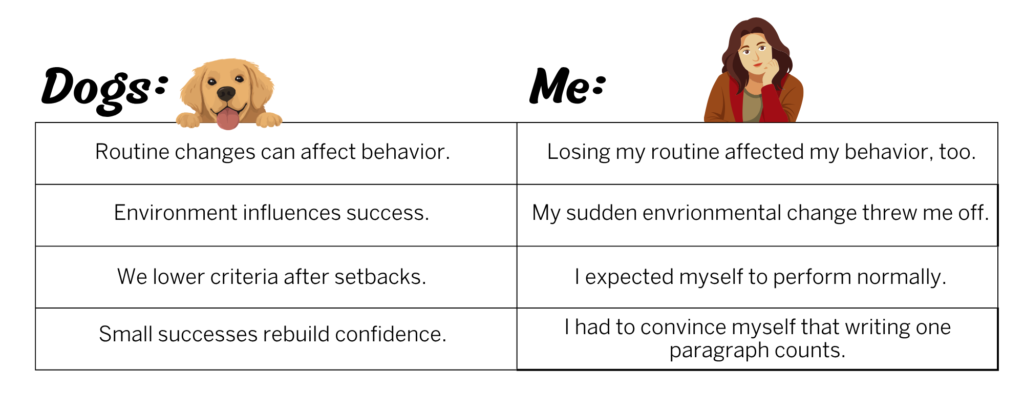
It is funny how quickly so many of us move into shame when we logically know that shame won’t actually help us move forward.
I tell my clients all the time:
Shame is energy wasted.
It doesn’t teach a dog a new behavior.
It doesn’t build confidence.
It doesn’t make the next step easier.
And yet, when it comes to ourselves, avoiding shame is much easier said than done.
How I Used Dog Training Techniques to Rebuild My ADHD Routine
I won’t pretend that everything is magically fixed. Getting back into my routine is still a work in progress.
But stepping back and looking at how differently I approach dogs and clients going through similar struggles made me realize something:
I needed to approach myself the same way I would approach one of my training clients.
Feeling stuck is incredibly common, especially for many neurodivergent people.
So instead of continuing to ask myself, “Why can’t I just get back on track?” I asked a different question:
“How would I advise a client who was feeling this way?”
In dog training, two of my go-to strategies are Micro-Training and Habit Stacking.
So I decided to apply those same strategies to my writing.
I stopped expecting myself to sit down and immediately produce a finished article. Instead, I focused on small moments of progress.
A few minutes of writing.
A few thoughts dumped onto the page.
A few sentences—even if they weren’t organized or polished.
The goal wasn’t to create something perfect. The goal was simply to reconnect with the habit.
And then something interesting happened.
Once I found a topic that grabbed my attention, my ADHD superpower kicked in: hyperfixation.
Suddenly, the words started flowing again.
The Next Time Your ADHD Routine Goes Off Track, Give Yourself the Same Grace You Give Your Dog
The next time your schedule goes off track and you find yourself stuck in an executive function spiral, try asking yourself a different question.
If your best friend described the exact same struggle, would you call them lazy?
Or…
If your dog experienced the same disruption, how would you help them rebuild their confidence?
You wouldn’t expect your dog to immediately bounce back after a major change. You would lower the criteria, create small opportunities for success, and celebrate the tiny steps forward.
You deserve that same patience.
Progress doesn’t always look like jumping right back into your old routine. Sometimes progress looks like writing for five minutes. Opening the laptop. Taking one small step toward the thing you love.
Those small wins matter.
Because just like with dog training, those tiny successes build confidence. And confidence creates momentum.
So if your routine falls apart, don’t assume you’ve lost your ability to do the thing.
Sometimes your brain just needs a little support finding the path again.