
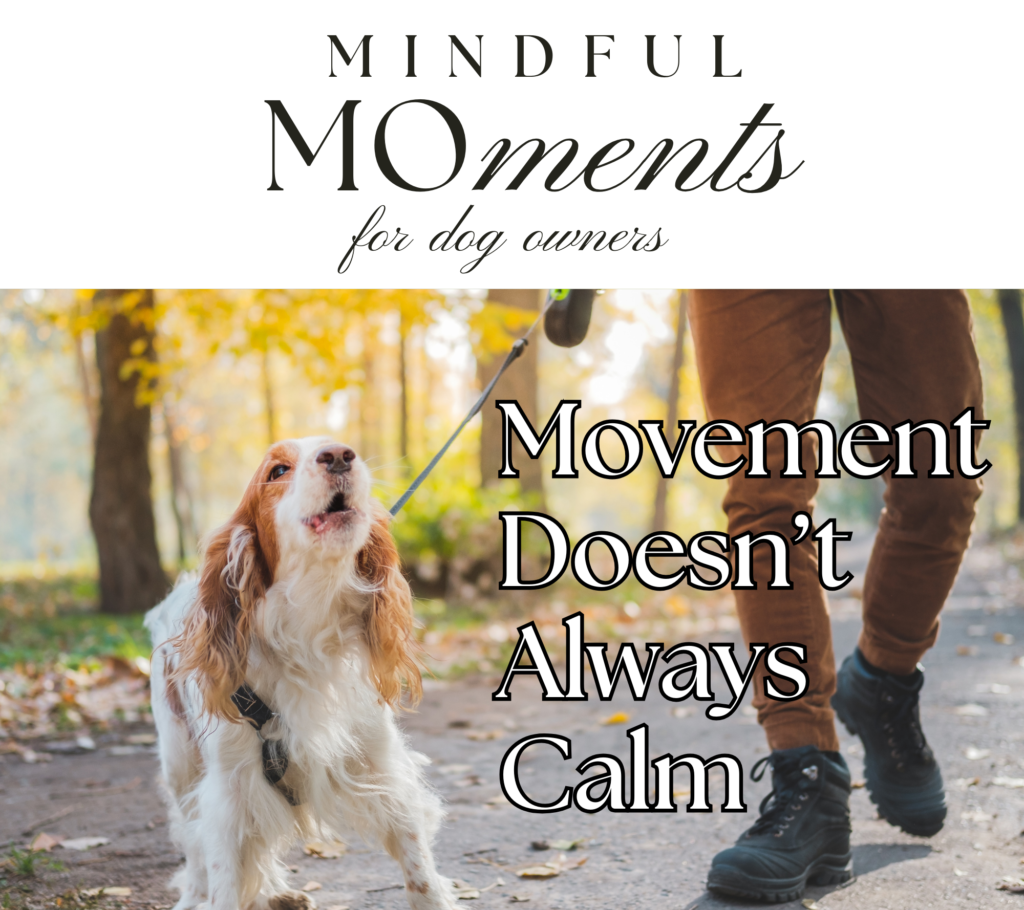
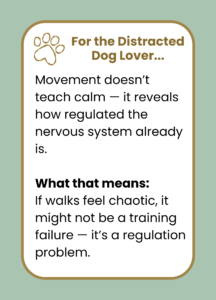
 This month, we’ve been focusing on building habits that support loose-leash walking.
Before we go any further, let’s pause and look at why movement can sometimes make focus harder — not easier.
Most owners walk their dogs to calm them down.
But in many cases, movement does the exact opposite.
My fellow ADHDers may already know where this is going.
Picture it with me.
You’re relaxing when you suddenly decide to get a snack from the kitchen. You stand up… but by the time you reach the kitchen, you’re overwhelmed.
You notice:
- The dishes piled in the sink
- Your dog staring at you, clearly requesting treats
- The mail on the counter that really should be sorted
Suddenly, you’re in sensory overload.
For many ADHDers, movement = activation.
Standing up opens the floodgates, and your brain starts taking in far more information than it was just moments ago.
With that activation comes dopamine-seeking.
Hey — doing the dishes might be a quick win. So, you start there… and completely forget about the snack you originally wanted.
Is this just me? I’d bet not.
Executive function — something the ADHD brain often struggles with — tends to lag behind movement. We rev up the engine… but forget the map to our destination.
Now, picture this from your dog’s point of view.
Your dog is resting calmly at home. Then you clip on the leash for a walk. The moment the leash comes out, everything changes.
When you step outside, your dog is suddenly hit with:
- New smells layered on top of old ones
- Sights of people, dogs, cars, and squirrels
- Sounds you can’t control
- The physical sensation of moving forward
That single transition — standing up and stepping out the door — opens the sensory floodgates.
Movement activates your dog’s brain, just like it activates yours.
You don’t need ADHD to recognize this feeling — but if you do have it, you probably felt it in your body while reading this.
The Big Misconception: Movement Always = Calm
 I’m not saying we should toss walks out altogether.
I just want us to approach walks with more insight.
The problem is that going for a walk just to burn energy often backfires. Instead of settling the nervous system, movement can amplify arousal.
Here’s why:
- The leash predicts excitement.
Many dogs have learned that the leash means something exciting is about to happen. Their nervous system ramps up before you even step outside. (I have an exercise that addresses that in this article) - The environment is overstimulating.
Walks are full of intense input — smells, sights, sounds, and motion layered all at once. For an already activated dog, excitement escalates instead of settling.
We also tend to mistake excitement for excess energy, when what the dog actually needs is nervous system regulation. In those cases, more exercise doesn’t help — it makes things worse.
It’s a lot like an overtired toddler. They don’t need to run more — they need help calming down, but their body doesn’t know how.
That’s how walks can quickly turn into a spiral: more pulling, more barking, more frustration — for both you and your dog.
Why Walking Often Makes Things Worse Before It Gets Better
When you take your dog for a walk in an already activated state, they’re more likely to pull, bark, and react to what’s happening around them.
Let me explain what this feels like using my ADHD brain.
You’re already a little on edge — maybe you’re rushed, keyed up, or mentally juggling a few things. Then you walk into a busy grocery store.
Within seconds:
- The lights feel too bright
- Music, carts, and voices hit all at once
- Your brain starts reacting before you’ve chosen a plan
Suddenly:
- You feel irritable or snappy
- Small interruptions feel big
In my case, this is usually the moment one of my kids texts me asking me to pick up just one more thing. And that extra request pushes me right over threshold.
If you’ve lived this, you know you’re not trying to be unfocused or reactive. Your nervous system is overstimulated and scanning for relief.
That’s the ADHD equivalent of pulling and barking.
Calm Is a Skill That Has to Precede Motion
This can sound easier said than done. But just like with humans, calm is a skill — and it can be practiced.
If I’m already over threshold, I know that jumping straight into something stimulating will usually make things worse. Before I head out, I might pause to meditate or do a few minutes of breathwork to help regulate my nervous system.
Those tools didn’t come naturally to me. Meditation, especially, did not appeal to my ADHD brain at first. It only became helpful once I found the right guidance and approach.
Our dogs are no different.
If we want calm behavior on walks, we have to support calm before the walk ever begins. That means offering activities that help regulate the nervous system — not just burn energy.
For most dogs, calming activities fall into three main categories. I use all three with most dogs, though you may find your dog prefers one more than the others:
- Sniffing
From scattered food to novel, low-pressure smells - Chewing
Think a stuffed enrichment toy or a safe chew - Licking
(I’ll share a few enrichment toy ideas below)
These activities help lower arousal and prepare your dog’s nervous system for movement.
Now, let’s put this into practice — and work on building calm before the walk.
Setting the Stage
If your dog is pacing, barking, or already amped up, they need help settling before the walk begins.
Start with a sniffing activity inside the house, like a simple treat search. Sniffing slows the heart rate and helps shift your dog’s emotional state.
Before moving on, make sure you’ve also been working on calm around the leash (linked above). That foundation matters.
Introducing the Leash Calmly
While your dog is engaged in their regulation activity of choice, take the leash out.
Then pause.
You’re looking for one small sign that your dog’s nervous system is settling — even just a little. That might look like:
- A pause in movement
- A weight shift back
- A sigh
- A softer body
When you see it, mark it quietly with a calm “yes,” then place a few treats on the ground to encourage more sniffing.
Clip the leash on and repeat the same process.
The Door Is Its Own Skill
For many dogs, going out the door is one of the hardest parts. The door itself predicts a lot of stimulation, so I often train this step separately from the walk.
If I’m short on time, I may use a spatula with peanut butter to keep my dog licking as we move through the doorway.
And I know what you’re thinking:
“Aren’t you just distracting them?”
Here’s the important part: while your dog is licking, we’re preventing a nervous system spike. We’re also pairing something that’s usually over-arousing (the door opening) with something calming.
When we change the emotional response to the doorway, the rest of the training gets much easier. And no — this doesn’t mean you’ll be walking around with a peanut butter spatula forever.
Once You’re Outside
Pause again.
Let your dog look around — but watch their body language. Is it soft, or stiff and on edge? If your dog is already over-aroused, a walk will likely wind them up even more.
Before I start walking, I play a simple attention game. It helps my dog settle, encourages check-ins, and gives me valuable information about where they are mentally.
If my dog is too over-aroused, I don’t walk them yet.
My Favorite Pre-Walk Game
Set-Up
- A real-life environment (your yard)
- Dog on leash
- High-value, easy-to-deliver treats
How the Exercise Works
- Toss a few treats on the ground close to you and let your dog sniff and find them.
- When they’re done, watch — do they glance back at you?
- If they do, mark it and toss more treats down.
- As check-ins become more reliable, you can gradually toss treats a little farther away.
Troubleshooting
My dog doesn’t check in with me
This usually means your dog’s nervous system is still wound up, the environment is too distracting, or the treats aren’t motivating enough.
Try practicing in a lower-distraction environment first, and continue offering other outlets to lower arousal — remember: sniff, chew, and lick.
My dog checks in, but still seems tense
Great observation. Don’t start the walk. Spend a few session helping your dog settle in the front yard with food hunts or short lick breaks.
Why These Exercises Work
Pausing before movement gives the nervous system time to settle. Sniffing slows the heart rate and relaxes the body. Reinforcing calm moments helps the brain and body stay regulated.
This isn’t about control or obedience — it’s about helping your dog feel safe and settled before the world gets big.
Calm Your Dog Before the Walk: The Missing Step in Loose Leash Walking
If your dog is already overstimulated before the walk begins, it’s unrealistic to expect them to suddenly respond better once we add movement and distractions.
When I suggest skipping a walk until we’re sure it isn’t building frustration, many people feel immediate guilt. But here’s something important to remember: walks are not the best — or only — source of exercise.
If your dog truly needs more physical outlet, playtime can be an even better option. I’m a big fan of play that allows dogs to move and practice impulse control in a way that isn’t frustrating.
Even then, play raises adrenaline. That’s why it’s just as important to follow it with decompression — sniffing, chewing, or licking — to help the nervous system settle back down.
Skipping a walk doesn’t mean you’ll never walk your dog.
It simply means we’re working on the nervous system response alongside the mechanics of loose-leash walking.
When calm comes first, everything else becomes easier.
In Conclusion
We’re all living in a multi-sensory world. One of the most helpful things we can do for our dogs — and for ourselves — is recognize that when we’re overwhelmed, moving more doesn’t always help. Sometimes, it just adds to the frustration.
When we take the time to support regulation first and offer outlets that truly soothe the nervous system, everything shifts.
Walks feel easier. Communication improves.
And life together becomes calmer — and a lot more fun — for both of you.