

 It’s the day before New Year’s Eve. And like clockwork, I just signed up for a weight-loss Facebook support group.
A new year always feels like the perfect time for a fresh start—a chance to create new habits and finally do the things we’ve been meaning to do.
And the fact that not one of my past resolutions has stuck past March hasn’t discouraged me from trying again.
Big promises, made with the best of intentions. But for many of us—especially those with ADHD—New Year’s resolutions often turn into a source of shame when we don’t follow through.
Most New Year’s resolutions don’t fail because we don’t care.
They fail because they ask us to be different people while living the same lives.
If we want real change, we have to work with who we are—not against ourselves..
Why resolutions set us up to fail
 If you’re neurodivergent, the idea of New Year’s resolutions probably draws you in like catnip. Setting goals gives us that quick hit of dopamine—and in January, optimism is everywhere.
Then we get swept up, overcommit, and set goals that don’t leave room for real life.
If this sounds familiar, you’re not alone. Psychology Today reports that more than 80% of New Year’s resolutions are abandoned by February.
For many people with ADHD, one small misstep can feel like total failure. This all-or-nothing thinking—often tied to rejection sensitive dysphoria (RSD) and perfectionism—makes it easy to give up entirely.
Miss a day? Break a rule?
“Well, I failed—so what’s the point?”
So this year, I’m reframing the whole thing.
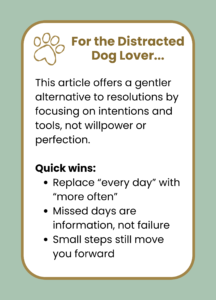
Instead of New Year’s resolutions, I’m setting New Year intentions.
What is an Intention
An intention is a mindset shift for your brain.
Instead of an absolute rule, it’s a direction you can move toward—one that allows flexibility, learning, and adjustment.
So instead of saying:
“I’m going to train my dog every day.”
Try:
“I’m going to train my dog more often.”
As a positive-reinforcement dog trainer, I’m constantly evaluating training setups to make sure my dog can succeed. If a session falls apart, I don’t label it a failure—I gather information.
That environment was too distracting.
That step was too big.
We need to make this easier before asking for more.
But like many people, I don’t always give myself that same grace.
Often, when I don’t meet a goal, it’s because the goalpost was set too high. With intentions, missteps become information—not proof that you should quit.
Intentions in Dog Training
Intentions work especially well for realistic dog training goals.
Instead of:
“I will train my dog for 30 minutes every day.”
Try:
“I will notice and reinforce focus when it naturally shows up.”
That single shift changes everything.
And instead of something vague and overwhelming like:
“I will fix my dog’s behavior,”
Focus on what you want your dog to do instead. That clarity creates a plan—and plans are easier to return to than pressure.
Tools to Help with Your Dog Training Intentions
Intentions are powerful, but they still need support—especially when distraction and time blindness are in the mix.
Here are a few tools I use and recommend to help turn intentions into action.
Write it down: Dog Training Goal Planner
When you say, “I want to train my dog,” the next question is: train what, exactly?
The Dog Training Goal Planner helps you break big ideas into specific, achievable steps. It acts like a guided journal where you can:
- clarify why a cue matters
- define how you want to use it in real life
- track progress without perfection
Simply writing goals down improves clarity and follow-through—so whether you use this printable or a notebook, getting it out of your head matters.
Work training into everyday moments: Habit stacking
The secret to building new habits? Pair them with existing ones.
Habit stacking weaves training into the flow of your day instead of asking you to “find more time.”
If this idea resonates, you can read more in Habit Stacking for Dog Owners. And if you want help getting started, I also offer Habit Stacking Cards with simple, realistic prompts you can actually stick with.
Don’t lose track of time: Pomodoro-style timer cube
Time blindness is one of my biggest ADHD traits. I either avoid training—or I hyperfocus and train far longer than is helpful.
Short training sessions are better for dogs and humans.
When I trained scent-detection puppies, time mattered. Going over with one dog meant another dog missed their turn. That pressure led me to a simple solution: a Pomodoro-style timer cube.
I just flip it to start the timer. It gives me a clear beginning and end—and keeps sessions short, focused, and successful. I now use it for dog training and everyday tasks where time tends to disappear.
A gentler way into the new year
As we head into a new year, keep dreaming about what’s possible—but approach it differently.
Setting intentions allows you to celebrate small steps forward instead of quitting when things aren’t perfect.
You don’t need a new version of yourself.
You just need tools that work with the life you already have.
Start small. That’s enough.