
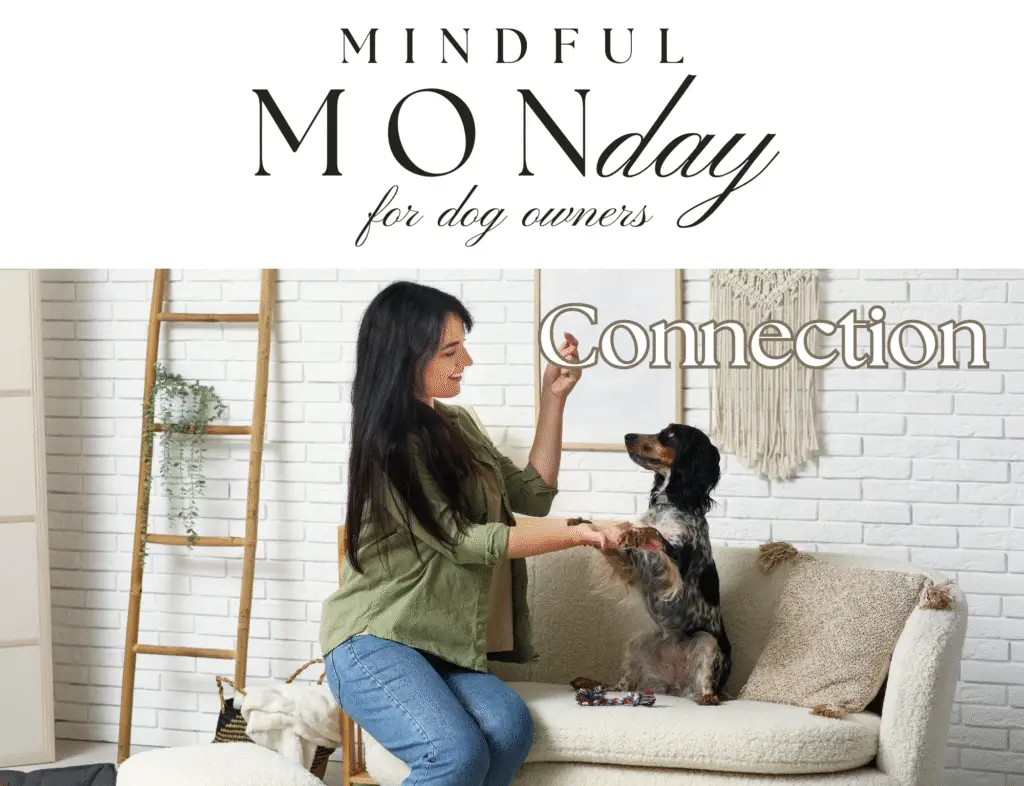
Now, a few of you may notice I have switched my Monday series from Monday Motivation to Mindful Mondays.
No, I didn’t forget what I originally called my Monday series (although that is a fair assumption!).
As I reflected on what I thought would be more helpful to both you and your dog, I wanted to focus on mindfulness. See, motivation can get us started, but mindfulness helps us stay connected. And that will have longer-term benefits for both ends of the leash.
Mindfulness exercises have been a crucial part of my wellness journey while learning how to navigate my life with ADHD. And I have been excited to work it into my training. It has motivated me, and I hope you find it just as helpful.
Table of Contents
ToggleCelebrate What Your Dog Already Does Well in a Confidence Boost Session
It is human nature to focus on what we don’t want our dog to do. Or to get stressed when our dogs aren’t great at useful skills (like loose leash walk). But when that’s all we notice, training can start to feel like a chore instead of a connection.
Let’s take some time this week to celebrate your dog’s strengths.
A few times a week, focus on what your dog already does well. This will give you both the chance to experience success (and the dopamine boost that comes with it). And you spend time together celebrating and appreciating each other.
Write down your dog’s “gold star” skills—the ones they already do well! Maybe it’s “sit,” or waiting patiently at the door. The more you focus on what’s going right, the easier it becomes to spot all the little things your dog does well.
My kids’ experiences with a math tutor actually inspired this training activity. One of my children was really struggling with math—and honestly, I can’t even pretend I was any help. (Let’s just say numbers, and I have a long-standing agreement to keep our distance.) So we found a tutor. Instead of diving straight into the tough stuff, the tutor started with simple problems during the first few sessions. At first, I wondered if we were wasting time—until I realized what was happening. By starting with what my child could already do, the tutor was rebuilding their confidence. Once they began to feel successful, they became more willing to tackle the more challenging problems.
The same thing happens in dog training. When we revisit skills our dogs already know and enjoy, we’re creating those early “easy wins” that rebuild confidence and motivation—on both ends of the leash. It’s not just about practice; it’s about reminding your dog (and yourself) that learning can be fun.
So your goal this week is to:
- Pick one or two cues your dog does well. It could be “sit,” “touch,” or “look at me,”
- Keep sessions short and fun. About three minutes is plenty. Set a timer if you need to (I know I lose track once I’m having fun!). Ending while your dog wants more will make them excited for the next session.
- Use lots of treats. Just because your dog is already good at something doesn’t mean we shouldn’t build on that with a solid foundation of reinforcement. The stronger we make it, the more we’ll be able to build on top of it later.
- Notice how you feel at the end of the session. Are you focusing on what your dog does well? That mindset shift can be incredibly helpful in building a stronger connection with our dogs.
That’s it! That’s this week’s game. It is okay if you want this to look a little different every day, but keep it simple. You want to plan for success. So, add some subtle changes, such as doing this exercise in a different room of your house each time. Or doing one session while standing and one while sitting. These subtle changes can help proof this behavior and make it even stronger.
Keep Building the Bond: Mindful Dog Training for Real-Life Success
When we shift our focus from “fixing” our dogs to celebrating them, training becomes more joyful. These short, mindful sessions are about more than practicing cues; they’re a reminder that your dog already brings so much good to your life.
By practicing what’s already working, you’re strengthening trust, confidence, and communication. That’s the real heart of mindful dog training. Not perfection, but partnership.